Staying up is the part you already measure. Proving a contact center is ready for its busiest operating period means reproducing the conditions of the season, and volume is only one of them.
Most contact centers have a few dates circled in red. Open enrollment for health insurers, Black Friday and Cyber Monday for retailers, the run-up to the April filing deadline for tax preparers. The events differ but the pressure doesn’t: a sharp spike in volume, a narrow window, and customers trying to resolve something before a clock runs out.
Open enrollment opens at nine. By twenty past, the queue is deeper than it gets in a normal week, and every dashboard you own is green. The platform is up, the trunks are fine, the error rate is flat. What none of that tells you is how many of those callers got what they rang for, or how many will ring again before lunch. A menu that behaves with ten concurrent calls can misroute, time out or drop people when hundreds are in it at the same moment, and none of that registers as an outage.
Not every peak arrives on a calendar either. An outage, a storm, a product recall or a release that goes wrong produces the same conditions without warning, and what you learn rehearsing the dates you do know about is what you have when one of those turns up.
So what separates a peak-season test from a load test? A load test reproduces the volume of the event. A peak-season test reproduces its operating conditions, and those are a longer list than volume. Systems can fail outright at peak, but more often they stay available while the experience degrades, in ways a concurrency number will not report.
So peak season IVR testing is a simulation of the traffic, call types, behaviors, session durations and downstream dependencies you expect during a specific event, measured for both availability and customer outcome. The useful question is not whether you ran one. It is whether you can show afterwards which of the season’s conditions you actually reproduced.
Seven of them make up the model. Together they give you a realistic test of seasonal readiness that reproducing traffic volume alone does not. Nor does working through seven categories badly: the quality of the scenarios and the concurrency you actually achieved decides whether the answer means anything, which is the subject of a later section.
| Load test category | What it measures |
|---|---|
| Traffic | The historical arrival pattern, the ramp into it, the sustained period and the cooldown, rather than a flat number held for an hour |
| Customer mix | The intents the season actually brings, the share of them needing authentication, and the session durations those produce |
| Voice | The accents, background noise, phrasings and interruptions your callers arrive with, rather than clean studio audio |
| Dependencies | The CRM, billing and eligibility systems the journey calls out to, including the mid-session lookups that only happen on some paths, and inventory and payment systems can experience extreme stress |
| Agent capacity | Sign-ins inside the shift window, sessions ready to receive, and routing and screen pop at the volume the day produces |
| Failure conditions | Slow lookups, failed transfers and the fallback paths, exercised deliberately rather than left to chance |
| Outcomes | Containment, completion, abandonment and repeat contact, measured per journey rather than in aggregate |
What the season looks like
The numbers set the scale.
In the 2026 filing season the IRS received 48.1 million taxpayer calls and answered 9.9 million of them, about one in five, with an average wait of 14 minutes. The season before, it took 50.2 million calls, answered 12.4 million, and averaged 8 minutes. Fewer calls came in, fewer were answered, and the wait nearly doubled.
Open enrollment compresses a similar surge into weeks, and there are two of them. Medicare’s annual enrollment window runs from 15 October to 7 December and covers around 70 million beneficiaries, about half of them in Medicare Advantage plans run by private insurers with their own contact centers. The Marketplace window opens on 1 November.
CMS reported 23.1 million Marketplace plan selections and automatic re-enrollments for the 2026 open enrollment period, which ran from 1 November 2025 to 15 January 2026 across HealthCare.gov and the state exchanges. Some of those were automatic. The rest are decisions with a deadline attached. For people who can’t complete the process online, the contact center becomes part of that journey.
Retail peaks are shorter and steeper. NICE reported an 80% year-on-year increase in digital interactions over the 2024 Black Friday and Cyber Monday weekend, on the traffic its own CXone platform handled, with single-day spikes of 143% and 120%.
Volume is only part of it, because the shape of the traffic changes as well. An IVR that leans on conversational AI or model-based routing carries failure modes touch-tone testing won’t find. Under peak concurrency a voice bot journey may time out, recognize more slowly, hit a downstream dependency failure or take a different routing path. The customer can get a different outcome even though nobody changed the deployed flow.
What to simulate
Start with the shape, because it is the one most test plans get wrong. An instant jump to full concurrency tests burst tolerance and stops there. A tax-season Monday morning looks nothing like an open enrollment deadline eve or a Cyber Monday flash sale, so model the curve for the event in front of you.
The mix is where a reasonable-looking test still passes. An enrollment period skews toward eligibility and plan comparison, long sessions carrying several data lookups each. A retail peak skews toward order status and returns, short and high in volume and heavy on authentication. A filing deadline skews toward payments and notice queries. Those three stress different parts of the same system, so a test built on an average month’s distribution can pass while the season’s fails. Examples illustrative; your own analytics for the equivalent period are the source.
Two of those conditions have a trap in them. Long sessions have to be in the mix because under load they hold channel capacity while new calls keep arriving. And automated IVR testing on identical clean audio will make readiness look better than it is. Our guide to IVR load testing for peak traffic works through the traffic model in detail.
What the season adds is triage. Few teams can test everything before one opens, so baseline what you have, then work through the journeys in order of what they cost you when they fail: the ones carrying revenue, the ones carrying a regulatory obligation, and the ones a customer would complain about publicly. Three journeys proven end to end will protect you better than thirty covered in part.
One thing to settle before any of this reaches production. Automated load testing against a live contact center platform needs the vendor’s permission first, and the request goes in ahead of the window rather than on the morning you want to run. Allow a couple of weeks. The window you get will usually be out of hours in the region the traffic lands in, which is worth knowing before you promise anyone a result by Friday. And unannounced load traffic reads as an attack, with the response an attack gets.
What to validate
A concurrent call target is the starting point. On its own it tells you the switch held. Five things underneath it tell you whether the season held.
Routing accuracy. It goes first, almost every time.
Speech and intent performance at concurrency. Recognition capacity is often provisioned separately from call handling, so the two can give way at different volumes and you will not know which one moved unless you were watching both.
Escalation and transfer completion. A transfer that behaves all week can loop, or time out, once the live-agent queue is taking hundreds of calls at once.
Backend dependency and authentication latency. This is the quiet one. A mid-session lookup that slows under peak can push a journey past a timeout, or send it somewhere else entirely, with no error written down anywhere.
Answer, policy and journey outcome consistency. The four above check whether the journey ran. This one checks what it said, by running the same intents at low concurrency, at forecast peak and in between, then comparing what came back at each level. It is the check peak tests most often left out, and on an AI-led IVR it finds what the other four cannot.
None of them is an outage. Every one of them is a customer who didn’t get what they called for.
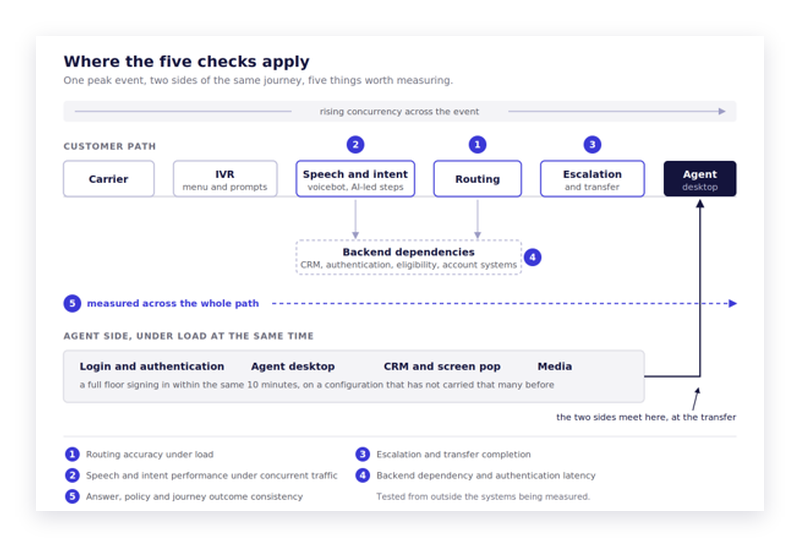
Where the five checks apply, on both sides of the transfer.
Can a load test pass when it should have failed?
A load test can pass when it should have failed, and that is worth checking about any load test, including one of ours, before you trust what it reported.
A call generator that queues what it cannot place will report a clean run on a fraction of the load you asked for. The requests went in, the generator held them, and the report shows what it managed rather than what you specified. The same thing happens at the carrier: ask for a burst the route will not take and the calls are paced, so the test is gentler than the day it was meant to rehearse.
So the number worth reading is not how many calls you requested but the highest concurrency that actually existed during the run, alongside whether the generator and the carrier sustained the arrival rate you asked for. Check both before you size the test, and read them again before you believe the result, because a clean report is the first thing to be suspicious of.
Both numbers belong in the result, next to the pass rate.
The other half of the load
Everything above tests the caller’s side of the line. At peak, the agent side is under load at the same time, and it’s tested far less often.
Think about what happens on the morning a season opens. A large floor signs in inside the same 10 minutes, and authentication, the agent desktop, the CRM behind it and the softphone all get hit at once by a population that was 50 people at 6am. Seasonal programs sharpen it, because many of those agents are temporary and signing in for the first time on a configuration that has never carried that many. If 2,000 agents sign in together and the login service buckles, every caller in the IVR is queuing for a floor that is not there yet.
Testing it means driving both sides of the same journey in one run: synthetic callers arriving through the IVR, and concurrent synthetic agent sessions signed in and receiving them, at the volumes you expect on the day. Those synthetic agent sessions can exercise the platform-side login, routing, interaction handling and media path without requiring a physical workstation for every concurrent session, allowing the test to scale beyond the number of desktops you can stand up. With PumpCX, the caller is synthetic. The test is real. The evidence is independent.
What to assert on that side is narrower than it sounds. Did the session sign in inside the window the shift pattern allows. Did the interaction arrive at a session that was signed in and ready, rather than at one the platform believed was ready. Did the customer record arrive with it.
That middle one is worth spelling out, because it is the failure nobody writes a test for. The platform shows a ready agent. The router sends an interaction. Nothing arrives at the desktop, or it arrives without the screen pop that carries who the caller is. The agent answers to silence or to a blank record, the caller repeats everything they already gave the IVR, and the platform logs a delivered interaction. Status said ready. Readiness was something else.
To the caller that is indistinguishable from a floor that is not there yet, which is why only a run driving both sides at once tells you which one you have.
What breaks differently when the IVR is AI-led?
An AI-led IVR is not a separate testing problem. It is the same seven conditions with more ways for them to reach the caller, because three of its parts degrade on separate clocks and none of the three announces itself.
Recognition first. Speech recognition is sensitive to the condition of the audio reaching it. Boson AI’s March 2026 arXiv preprint put a simulated phone codec in front of seven recognizers and average word error rate on read speech went from 4.1% to 10.4%. Boson AI builds speech models, so read that as vendor-published research rather than independent, and it is a codec figure on read speech, not a packet-loss figure. No modern figure exists for what packet loss under congestion does to a current recognizer, and the honest thing is to say so rather than fill the gap by inference. What it tells you is that the recognizer is the part most exposed to whatever the network does at peak.
Then the shape of the response. A model under pressure may not return the same length of answer it returned in rehearsal, and length is not a cosmetic property in voice: a longer answer holds the channel, moves the barge-in window and changes where the caller interrupts. Assert on whether the answer stayed inside the bounds you set, not on whether the wording matched.
And the tool calls. When an agent calls out to a billing system or a policy lookup and the call comes back late, the agent has to decide what to say in the meantime. Under load that’s where invented detail appears, and where an agent narrates a step it hasn’t completed. Assert that the tool was actually called, and that what the caller was told matches what came back.
What does the season do to your disclosures?
A disclosure obligation does not scale down when the system is under pressure, and a disclosure is exactly the kind of thing a degraded path drops. The disclosure lives at the start of the interaction, which is the part a fallback route is most likely to skip, so the test has to assert it fired on every path including the ones that failed over. California’s AB 1609 and Article 50 of the EU AI Act both put the obligation on the interaction rather than on the happy path.
One boundary on the test itself, because it comes up every time. No test of ours places traffic to a public emergency service. Where this page says an emergency line it means a commercial one, an insurer’s claims number or a roadside assistance line.
Why a few points of containment may not be producing success
Each of those checks describes one way a journey can fail. At peak, the failures feed each other.
Containment is the mechanism. When the IVR or the voice bot degrades, some share of the callers it would have handled, end up with an agent instead. Those callers were already in the building, so nothing has been gained. Work has moved from the cheap side of the operation to the expensive side, on the one day the expensive side has no slack and may, as above, still be signing in.
Take a 40,000-call day and an assumed containment rate of 65%. On that assumption 14,000 reach the floor. Let degradation pull containment to 58% and the floor takes 16,800. Same 40,000 customers, 2,800 more agent conversations, no extra revenue anywhere. Figures illustrative, and the arithmetic is the point rather than the numbers: put your own containment rate and your own peak-day volume through it and the shape holds.
One caution on the word. A contained call is one that did not reach an agent, which is not the same as a customer whose problem was solved. Some hung up. Some will ring again tomorrow. Containment tells you where the cost landed; completion tells you whether the season worked.
Then it compounds. Longer queues create abandons and callbacks, and callers who fail on voice try another channel, so a small containment change can create demand somewhere you were not watching.
Which is why a peak test that reports availability has answered the wrong question.
When should you run a peak-season IVR test?
Start far enough ahead that a finding can still become a fix. Most teams start too late.
The window is set by the event rather than by the quarter. Count back from the date far enough that a finding can still become a fix: time to run, time to read the result, time for whoever owns the flow to change it, and time to re-run. Vendor approval for load traffic sits inside that arithmetic, not alongside it.
Then keep testing once the season is running, which is also the answer if a season is already close. In-season testing is not a consolation prize. Configurations change during a season, often under pressure, and the change made on a Tuesday to relieve a queue is the one nobody re-tested.
What you should have at the end of the test
Judge it on the output. Two questions do most of the work.
Can it show exactly which journeys degraded? This is the output that changes what you do on Monday. A pass rate tells you there was a problem; a named journey, with the point in the ramp where it started to go, tells somebody what to fix.
Can someone reviewing the test six months later see what happened? Peak seasons get reviewed afterwards, usually by somebody who was not in the room, and a result that cannot be reconstructed from its own record is an assertion rather than evidence. What makes it reconstructable is that it was captured from outside the platform being tested: what the synthetic caller heard and said at each step, what the connected systems returned and how long they took, and the point in the ramp where the journey started to go. A platform’s own report describes its own performance. This is the other record.
The point of the exercise
Seasonal failures are rarely total outages. They’re smaller breakdowns that add up fast: a misroute, a timeout, a failed transfer, a slow backend call that sends people back around the loop. More abandonment, longer waits, more repeat contacts, at the worst possible moment.
PumpCX runs the season rather than the volume: the traffic shape, the customer mix, the voice, the dependencies, the failure paths and the outcomes, driven from outside the platforms being tested, with synthetic callers arriving through the IVR and concurrent synthetic agent sessions signed in to receive them. What comes back is a record per journey: which ones degraded, at what point in the ramp, and what the systems behind them returned when they did. That is the thing you can put in front of somebody who was not there.
When you last load tested your IVR, did you measure whether it stayed up, or whether your customers could still do what they called to do?
Frequently Asked Questions
-
Peak season IVR testing is a simulation of the traffic, call types, behaviors, session durations and downstream dependencies you expect during a specific event, measured for whether customers completed what they called to do. The season sets the shape of the test, so a tax-season Monday and an open enrollment deadline eve are modeled differently.
-
A capacity test asks whether the platform stays available at a target number of concurrent calls. A peak-season test asks whether callers still complete the journey they rang for at that volume, with the call mix and traffic shape the season produces. A system can pass the first and fail the second on the same morning.
-
You load test AI by asserting on the three things that move under pressure, rather than on whether the wording comes back the same. Recognition accuracy at concurrency. The shape of the response, and whether it stayed inside the bounds you set. Whether the tool calls behind it actually completed. Whether what the caller was told matched what should have come back. All three are checkable without a fixed expected string, which is what makes them usable on a system whose exact words change between runs.
-
Item description