Testing tells you it worked. Assurance proves it still does.
Why independent CX assurance is different from testing and monitoring
With every vendor now claiming some form of testing, monitoring or assurance, I think we’re in danger of losing an important distinction. Testing asks whether something worked. Monitoring asks what is happening. Assurance asks whether you can independently demonstrate that the customer journey is still delivering what was promised.
Those are different jobs.
I’m pleased the market is taking assurance seriously. After more years in this industry than I care to admit, I’d much rather see organizations thinking about assurance than treating testing as something that happens once before go-live.
I wrote about why testing alone stopped being enough back in April. The question I keep coming back to is narrower: if assurance is going to become a category of its own, what does it actually mean?
Assurance needs independence
The simplest comparison is financial assurance.
An organization doesn’t establish the accuracy of its accounts simply by running its own checks and declaring them correct. Independent assurance exists because the person assessing the result needs sufficient separation from the person responsible for producing it. Independence isn’t the whole job, but it is fundamental to the credibility of the result.
I believe CX needs the same discipline.
If the same platform that provides an AI agent also provides testing and reporting for that agent, that’s useful, and the platform should absolutely test its own software. But it answers a particular question: does the system behave as designed? That’s different from asking whether the complete customer journey works, and whether anyone independent can prove that it does.
The same distinction applies to monitoring. Observability is valuable. It can show latency, errors, resource utilization, failed requests and plenty of other signals, and it can identify an unhealthy component before customers experience a failure. But it’s still watching systems rather than experiencing the journey, and it may tell you a component is healthy without telling you whether the customer can complete what they came to do.
The carrier can be healthy.
The IVR can be healthy.
The routing can be healthy.
The voicebot can be healthy.
The CRM can be healthy.
And the customer can still have a bad interaction.
The failure is often in the seam between those systems. That’s why assurance has to start from a different place.
Assurance starts from the outside
CX assurance should experience the journey the way a customer does. It should enter through the channel a customer uses, follow the journey, exercise the decisions and handoffs along the way, and determine whether the outcome matches what was promised.
It should also leave behind evidence:
what happened
when it happened
which journey was tested
what the system said
what the customer experienced
whether the expected outcome occurred, as far as the systems behind it can be checked
That evidence matters because assurance isn’t only about finding something broken. It’s about being able to demonstrate, independently and repeatedly, that something is working.
This becomes particularly important with AI. A deterministic IVR is easier to reason about, but it still depends on configuration, integrations and downstream systems. An AI agent can also take different paths, respond differently to the same intent, and change when the model, prompt, knowledge base or integration underneath it changes.
That last point catches people out. Your own configuration can sit untouched for a quarter while the model underneath it is updated, the knowledge base is re-indexed or an integration is upgraded. A guardrail that held last month may not hold today, even though nobody on your team changed anything.
Which is why the test has to run on a schedule rather than at a milestone. If the thing being tested can change without you changing it, a release-gated test can only tell you about the release. A test that passed before a platform update tells you what happened before the update. It doesn’t prove what’s happening now.
Assurance is not a feature you switch on. It’s a discipline you keep doing.
Every interaction has two ends
A lot of the testing I see covers the customer end. Someone calls in, works through the bot, follows the journey and confirms the outcome. That’s the right place to start, and it’s also where many programs stop.
The other end is the agent’s. A voicebot can transfer a call successfully while the agent gets nothing useful with it. Did the screen pop fire? Was the screen data right? Did the account number the IVR collected land in the right field? Did the context arrive at production volume rather than pilot volume? Or did your agent receive a stranger who has to start again?
The call sounds connected either way. The customer only discovers the difference when they’re asked for their account number a second time, or have to repeat the reason they called, and by then you’ve spent the goodwill the automation was supposed to earn.
That failure may not appear in either dashboard. The bot reports that it transferred. The agent platform reports that it received. Neither system is wrong, and neither is measuring the complete interaction.
The problem becomes more acute at scale. A platform that handles one test call flawlessly can fail at the 200th concurrent agent login. A floor of 300 people arriving at once is a different test from three people signing in during a quiet hour. A migration signed off against a pilot of 10 may fail at 2,000. The first measurement that matters is often a floor full of people on the day you least want issues.
Assurance therefore needs to run from both ends at once. Enter as the customer, and be present as the agent on the same call, checking what arrives on the other side.
That doesn’t mean watching people work. It means running a synthetic agent session, signed in on the same platform your team uses, taking a test call and reporting what happened. Only the caller and the agent session are synthetic. The call, the journey and the systems are real.
Testing, monitoring and assurance
The three are complementary. The simplest way to distinguish them is by the question each one answers.
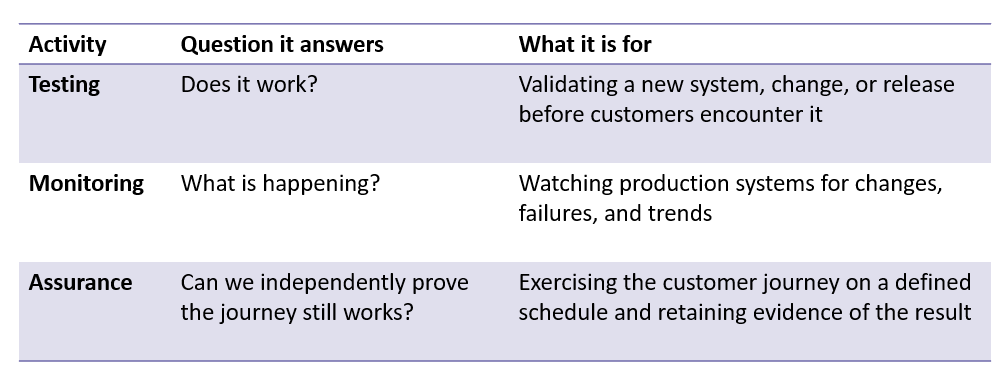
You need all three. Testing without monitoring leaves you blind to what happens after release, monitoring without testing means you discover some problems only when they reach production, and neither on its own gives you independent evidence that the complete customer journey delivered the intended outcome.
Where PumpCX sits
That’s the problem PumpCX was built to solve.
PumpCX is an independent assurance company, working across the carrier, IVR, routing, voicebot or agentic AI, integrations, handoffs and agent experience as one journey. We work alongside the testing, monitoring and contact center quality assurance organizations already have, and we don’t seek to replace it. We’ve written separately about what that asks of a platform.
Our role is to exercise the whole journey from outside the platform being tested. The same test cases drive the customer side while synthetic agent sessions receive the interactions on the customer’s own platform, so both sides of the handoff can be checked in the same run. Where the relevant internal systems are accessible, the evidence can extend to the record the journey was expected to create, update or retrieve.
The result is an independent record of what happened when a journey was exercised end to end, through the live environment.
Assurance is what happens after the test passes
Assurance exists to give you confidence that the thing you signed off is still the thing your customers are experiencing. Another score or another dashboard can’t provide that on its own.
The question is no longer simply:
Did it pass its test?
It is:
Can you prove it still works today?
That’s the discipline of assurance.
Questions we get asked about assurance
Is assurance the same as monitoring?
No. Monitoring watches the systems and reports what they are doing, which is useful and is not the same as knowing whether a customer could finish what they called about. Assurance exercises the journey itself, from outside the systems being tested, and keeps a record of what happened. A platform can report every component healthy while the handoff between two of them drops the customer’s context.
Can a platform assure its own AI agent?
It can test it, and it should. What it can’t do is provide the separation that makes the result credible to someone else, which is the same reason an organization doesn’t audit its own accounts. If the party that built the system also defines the test, runs it and reports the score, the score is an engineering artifact rather than independent evidence.
How often does assurance need to run?
On a schedule, rather than at a milestone. The thing being tested can change without anyone on your team changing it: a model update, a re-indexed knowledge base, an upgraded integration. A test tied to your own releases can only tell you about your own releases, so the useful question is how long you are willing to go without knowing.