Metrigy surveyed 656 companies for its Customer Experience Optimization: 2025-26 study. 34.7% already use CX Assurance tools. Another 52.5% have them on the roadmap or are evaluating.
So nearly 9 in 10 companies are shopping or have shopped in this category. I'd bet most of them would struggle to define what they're shopping for.
The word that trips people up is "tools." You can buy tools. CX Assurance is what you get when you design, build, deploy and monitor a customer support system with enough care that it delivers the service you intended, and tells you where it's breaking when it doesn't.
That's a result. Results come from an approach, and tools serve the approach.
How is CX Assurance different from testing and monitoring?
People use these three terms interchangeably. They answer different questions.
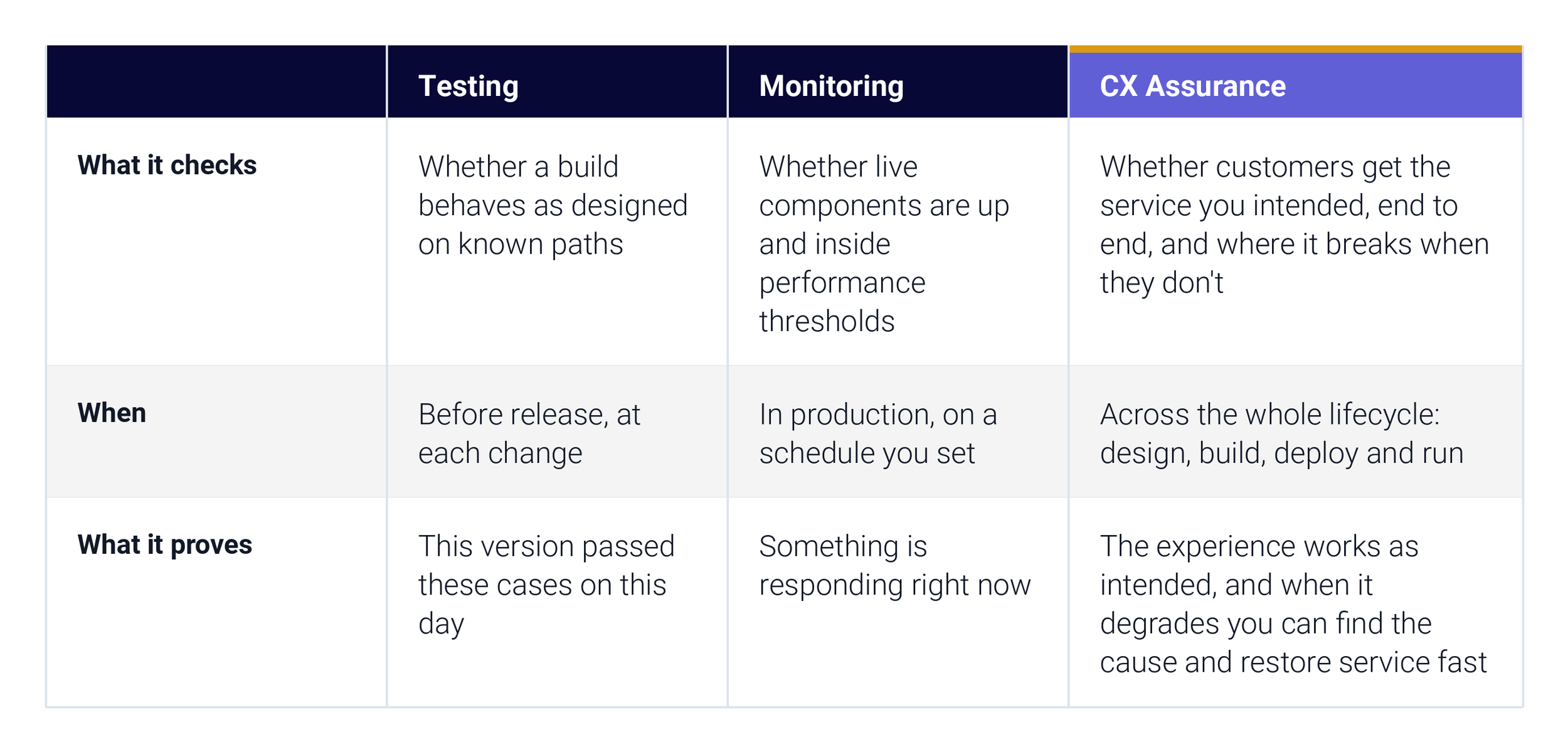
Testing tells you a version passed. Monitoring tells you something is answering. Neither one, on its own, tells you whether a customer calling at 2:47am got what you promised.
Assurance sits on top of both. It's the discipline that decides what to test, what to watch, and what the results have to prove.
A company can run 10,000 regression tests a week, keep a green dashboard on every component, and still have no assurance. Nobody asked whether the whole journey works for the person on the other end.
Why does AI make CX Assurance urgent now?
IVRs were predictable. Press 2, hear the billing menu. Every time. You could map every path, write a test for each one, and know when you were done.
AI agents broke that. Ask the same question twice and you can get 2 different answers, both plausible, one wrong. A prompt tweak on Tuesday can quietly change how dozens of flows behave. Your model provider can ship an update you never asked for. The agent that passed last month isn't the agent running today.
That's why Beth Schultz of Metrigy argues for pairing pre-deployment testing with continuous monitoring and observability after launch. I agree, and I'd push one step further. The pairing only works if someone owns the question both are meant to answer: is the customer still getting what we designed? Without that owner, you get two tools, two dashboards and two teams pointing at each other during an outage.
The stakes went up too. In 2024, a Canadian tribunal ordered Air Canadato honor a bereavement discount its website chatbot had made up. The airline argued the bot was responsible for its own words. The tribunal didn't buy it.
Small money, big precedent: whatever your AI agent tells a customer, you said it.
Buyers feel this. In Metrigy's data, 48.4% of companies named new risks from AI and automation as the top reason they're adopting CX Assurance tools. Gartner expects 60% of software engineering teams to use AI evaluation and observability platforms by 2028, up from 18% in 2025.
One caution on the survey data. Metrigy also found its most successful companies use CX Assurance more often than their peers. That's correlation. Well-run CX organizations probably buy more of everything.
Then there's the governance gap. Most companies with customer-facing AI have a responsible-AI policy. Far fewer have running checks that prove the policy holds. A policy nobody executes is a PDF. The space between what your policy promises and whether your guardrails actually hold is where the next incident is waiting.
Volume is the last problem. Testing an IVR means one test per path. Testing an AI agent means hundreds of conversations per intent, rerun after every change. No QA team has the hours to do that by hand.
Why does independence matter?
Platform vendors now ship ways to test their own agents. NiCE Cognigy made its Simulator generally available in January 2026, and others are building the same thing.
Those tools are useful for builders. They also produce first-party evidence: the platform reporting on itself.
Look at what happened at one global telecom carrier, documented in a vendor-commissioned Metrigy study. The carrier launched an AI agent that told customers they owed balances on accounts already paid in full. The QA team brought in an independent test framework. In pre-production, it delivered a 300% improvement in defect detection over the tests the AI provider had been running.
Same agent. Different grader. Very different picture.
That's the structural problem. The platform vendor sees the platform. The carrier sees the network. The LLM provider sees the model. Your customer sees all of it at once, and you're the only party accountable for the whole thing.
I worked with a regional bank that got acquired mid-deal. The CIO insisted on testing the phone system to full capacity. The Director of IT said it wasn't necessary. The CIO won the argument.
The first capacity test hit busy signals before the system reached half its expected load. Half the carrier capacity had never been provisioned. The bank had been paying for thousands of lines it couldn't use.
Nothing upstream flagged it. Every component looked fine from where it sat. Calls placed from the outside, the way customers place them, exposed the gap in one afternoon.
That's what outside-in evidence means. You test from the customer's seat: real calls and chats, over real carriers, through every layer, judged against what the customer was supposed to get.
What does good CX Assurance evidence look like?
If assurance is a result, evidence is how you prove you have it. Here's the bar I'd hold it to.
It comes from the outside in. It's generated over the same channels and networks your customers use.
It's statistical for AI. One pass proves almost nothing about a probabilistic agent. Run each scenario many times and report a pass rate. A scenario that passes 97 runs out of 100 tells you more than one green run ever could.
It's reproducible. Timestamped, versioned, and rerunnable by someone other than the person who ran it first.
It points to a cause. A failed call should come with the recording, the transcript, the signaling trace and the layer where it broke. A result that just says "failed" starts a meeting and fixes nothing.
It knows how accurate its grader is. More on this below.
It measures recovery. How often do failures happen, and how long do they last? Time to detect and time to repair belong in the evidence next to pass rates.
The grader point needs more room, because it gets skipped constantly.
AI agent testing leans on AI judges, what the industry calls LLM-as-a-judge. A model reads the transcript and decides whether the agent did its job. So who checks the judge?
The only published benchmark I've found, "Testing the Testers" (arXiv, revised January 2026), compared 3 voice AI testing platforms against human reviewers. Agreement ranged from 62.7% to 86.7%. One caveat: Evalion wrote the study, and Evalion's platform scored highest. Be skeptical of the ranking. The spread is what matters.
If your grader agrees with a human 63% of the time, it disagrees with a human reviewer more than a third of the time, and your green dashboard inherits that error. Ask every vendor, including the one you already pay, what their judge accuracy is and how they measured it.
A result you can't reproduce is a marketing claim. A result you can reproduce, with a known grader and a traceable cause, is a control.
So what is CX Assurance?
CX Assurance is an outcome. It comes from a thoughtful approach to designing, building, deploying and monitoring a customer support system.
Done well, that system delivers the service experience you intended. When something fails or starts to degrade, it helps you find the source fast, so service interruptions happen less often and last less long.
Tools help produce that outcome, and you'll need good ones. The outcome itself belongs to you.
Frequency and duration. Those are the 2 numbers the customer on hold actually feels, and they're the 2 numbers your assurance practice should be able to put in front of the board.
If you can't produce that evidence today, what you own is a set of tools. The assurance is still yours to build.