Every software defect carries a cost. The question is whether you pay it early, when it is cheap, or later, when it is very expensive. Continuous testing is the discipline of making sure you always pay early.
The Case for Continuous Testing
In CX and contact center operations, the word “continuous” gets applied to almost everything: continuous integration, continuous delivery, continuous improvement, continuous monitoring, and now continuous testing for CX journeys and AI assistants.
But when most organizations describe continuous testing, especially in the contact center, they mean something far less ambitious. A test suite that runs weekly, at the end of a sprint, or whenever QA has capacity is not continuous testing. That is periodic testing with a modern label, and it leaves CX leaders exposed to customer‑facing defects they do not discover until customers complain.
For CX assurance, continuous testing must mean something precise: no customer‑impacting defect goes undetected for more than 24 hours across your contact center and digital channels. When a routing rule changes, when an IVR prompt is edited, when a new AI model goes live, when a chatbot flow is updated, the CX layer must be tested immediately and the results known before the next workday begins. The maximum exposure window for a broken experience is a day. Not a sprint. Not a quarterly release. A day.
“The cost of a defect is not fixed. It compounds. A broken IVR menu or a misaligned AI answer discovered in 24 hours costs a fraction of what the same issue costs after three months of live customer traffic have been built on top of it.”
Why 24‑Hour Continuous Testing Is a CX Issue, Not Just a Dev Issue
Customer experience is a layered system. Every change to routing, every bot intent, every data integration built today becomes the foundation for tomorrow’s promotions, campaigns, and automation. When a defect is introduced in that stack and goes undetected, customer journeys continue to run and every interaction after that defect is suspect.
By the time an issue surfaces in a traditional CX testing cadence or through the contact center floor (“we are getting a lot of calls about X today”), it may be buried under weeks or months of subsequent changes, campaigns, and AI tuning.
The practical consequence is CX rework, one of the most destructive forces in CX economics.
Operations teams firefight instead of improving journeys.
Engineers and admins unwind configurations and integration logic long after they were deployed.
Brand and legal teams clean up after high‑visibility failures that were avoidable.
Rework is not simply fixing a bug in a journey or prompt. It is re‑examining assumptions, unwinding decisions, rebuilding flows constructed on a faulty premise, and re‑testing everything that touched the affected path across voice, chat, messaging, and web. In severe cases, it means restarting significant portions of an application entirely. Teams that have lived through this experience rarely forget it, and the organizations that fund them rarely forgive it.
Development and CX teams that have survived a major rework event understand intuitively what the data confirms: the cost of a defect discovered after months of development is not ten times the cost of early detection. It can be one hundred times or more, once you factor in lost engineering time, delayed go-live dates, and the organizational damage of a missed commitment.
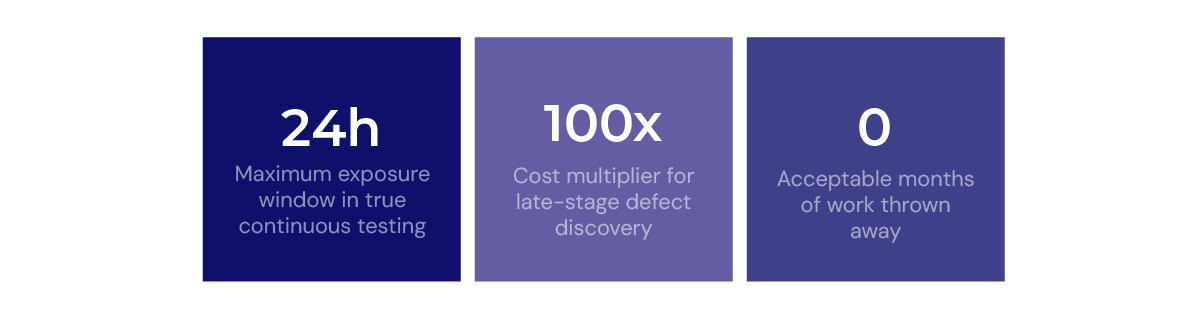
The 24‑hour rule behind continuous testing is not arbitrary. It corresponds to a natural unit of change in CX operations: a single day’s work. A defect found within 24 hours of introduction can be resolved before it is buried. A defect found after 24 hours has already begun to accrete. Every day that passes after that raises the cost of resolution, not linearly but exponentially, as more decisions are made downstream of the broken assumption.
Hard Costs, Soft Costs and the Manufacturing Analogy
There is a temptation in software and CX operations to treat defects as a routine noise, something to be managed with bug trackers, Jira queues, and post‑incident reviews. This framing obscures the true economic picture. Defects in CX, like defects in any manufacturing process, carry both hard and soft costs. Both are real, and both deserve to be accounted for honestly.
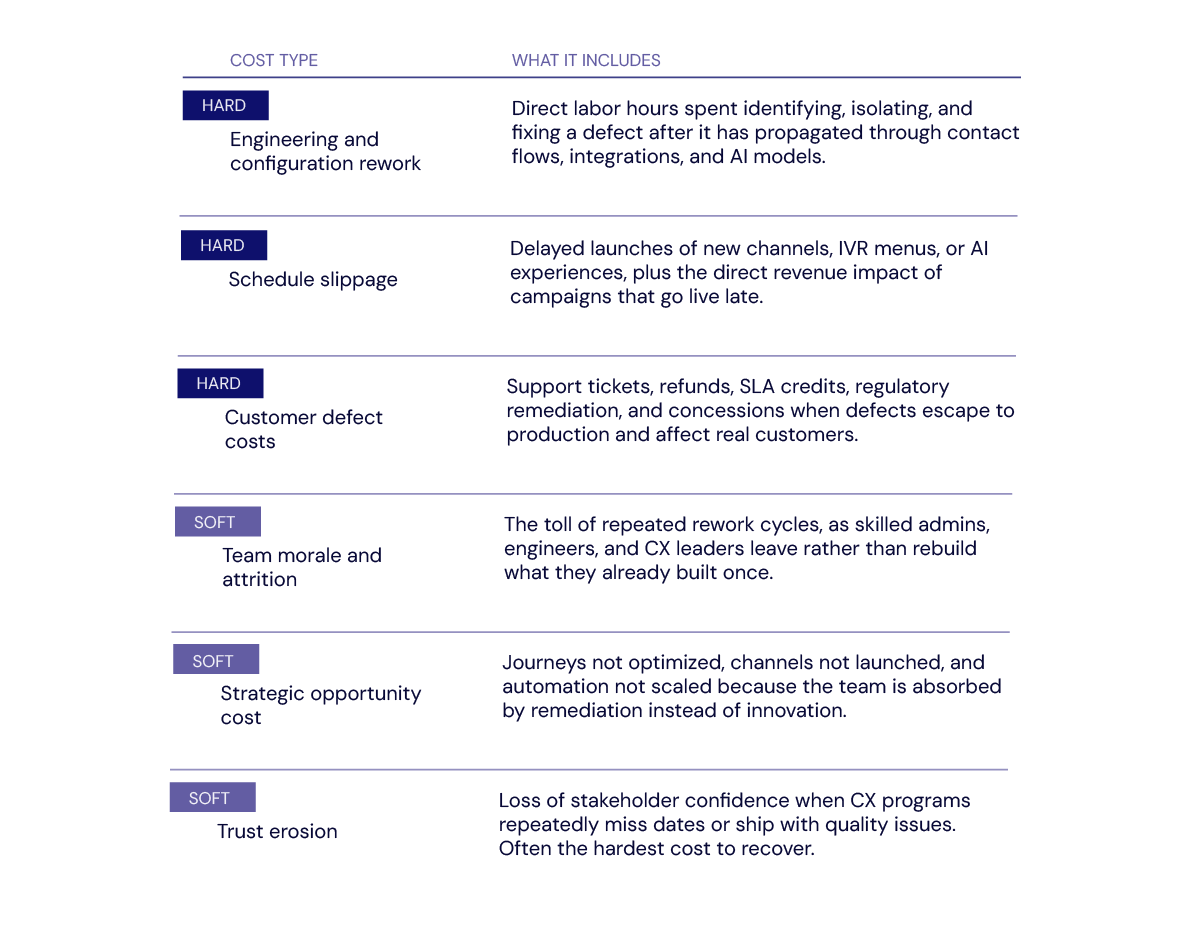
No manufacturer would accept a quality model in which defects were only discovered after the finished product left the factory. The automotive industry learned this lesson decades ago. Aerospace learned it at enormous cost. The principle is identical in CX. The earlier in the production process a defect is identified, the lower the total cost of that defect. This is not a hypothesis. It is one of the most well-documented findings in software engineering.
Continuous testing is the CX equivalent of in-line quality inspection on a manufacturing floor. It does not eliminate defects. It ensures they are caught at the point of introduction in your IVR, routing, or AI model before anything downstream is built or launched on top of them.
CX assurance is the outcome of this discipline. Continuous testing is the mechanism that makes it operationally real.
If the Value Is This Obvious, Why Aren't More Organizations Doing It?
This is the question that should trouble every CX technology leader.
The economics of continuous testing are not subtle. The rework cost of a late-stage defect is not a matter of debate, particularly when it hits customers at scale. The value proposition is clear, the case studies are abundant, and the engineering community broadly understands the principle. And yet most organizations are not practicing continuous testing in any meaningful sense.
The answer, almost always, comes down to cost. But not in the way most people assume.
The “Port Pricing” Trap That Makes Continuous CX Testing Economically Impossible
The fundamental problem is that testing capacity today is sold as a scarce commodity. Testing platforms are priced in ports: the number of simultaneous test channels or concurrent sessions a customer has licensed for voice, chat, or digital journeys.
This pricing model forces organizations into a rationing posture. When testing capacity is finite and metered, organizations are incentivized to use it selectively:
Run the big regression suite before a major release.
Spot-check the critical path before go-live.
Save capacity for when it is truly needed.
The result is a testing strategy designed around vendor pricing rather than engineering and operational outcomes.
When testing is priced by the port, scarcity becomes a feature of the vendor model. Organizations are forced to ration the very thing that should run without interruption.
Organizations are not choosing periodic testing because they believe it is a best practice for CX assurance. They are choosing it because their testing infrastructure cannot support anything more frequent, and acquiring more capacity would require a budget conversation that rarely ends well. This is a structural failure of the CX testing market, not a failure of intention. The teams know continuous testing is better. They simply cannot afford the capacity required to practice it under the prevailing pricing model.
The Multi‑Vendor Complexity Problem Across CX Channels
There is a second, related barrier worth naming: the multi-vendor complexity problem. Many organizations have accumulated testing and monitoring tools the way they accumulated contact center technologies, one acquisition at a time and one channel at a time.
Voice testing from one vendor.
Chatbot testing from another.
Digital journey testing from a third.
Each tool carries its own interface, its own skill requirements, and its own reporting format. Running continuous tests across all channels requires a team of specialists who speak each tool's language fluently. That team is expensive, difficult to hire, and difficult to retain.
And so, once again, organizations ration.
They test a subset of critical paths. They rely on synthetic checks that do not reflect real customer journeys. They depend on production incidents and agent feedback as a proxy for continuous testing.
This is the opposite of CX assurance. It is CX exposure, managed by best effort and heroics.
What CX Leaders Should Demand From Continuous Testing
The path out of this trap is not to spend more money on the same broken model. It is to start with the testing process your CX and AI outcomes actually require and then find a partner whose technology and financial model can bring that process to life at the scale and frequency you need.
For executives responsible for customer experience, that means reframing continuous testing as core CX assurance infrastructure, not an optional QA feature. A credible continuous testing strategy for CX should deliver:
A 24‑hour maximum exposure window for new defects across your contact center and digital channels.
Unlimited or near‑unlimited test execution aligned to your change rate, not your license tier.
One platform that delivers continuous testing across all media types, including voice, IVR, chatbot, conversational AI, digital journeys and emerging agentic interfaces, through a single unified environment. One interface. One skill set. One view of your entire CX estate.
Automation that runs without specialist intervention so that continuous testing is a background process, not a hero project.
Once these conditions exist, continuous testing becomes a predictable engine for CX assurance rather than an aspirational slide in a transformation deck.
A Different Model. A Different Result.
PumpCX was built on a simple conviction: the testing process should be designed first, and the vendor should be selected second. Too many organizations have allowed vendor pricing and vendor-imposed capacity limits to dictate how they test. We believe that is exactly backwards.
PumpCX delivers continuous testing across all media types, including voice, IVR, chatbot, conversational AI, digital journeys and emerging agentic interfaces, through a single unified environment. One interface. One skill set. One view of your entire CX estate.
Critically, we do not impose scarcity. PumpCX is not priced by the port. We do not create artificial capacity constraints that force our customers into rationing their testing resources. When you need to test everything, every day, at whatever scale your deployment demands, the infrastructure is there. The economics do not punish you for doing the right thing.
The outcome we are optimizing for is simple: no defect older than 24 hours, across every channel you operate. That is continuous testing, not as a marketing term but as an engineering commitment. The rework that consumed months of your last project cycle, the schedule impact of a defect that was introduced eight sprints before it was discovered, the soft costs that never appear in a post-mortem but are felt across the entire organization: all of it flows from a single failure to test continuously.
You already know what it costs when things go wrong. PumpCX exists to make sure you avoid those costs.