Ask, Don’t Navigate. Introducing QAI, the first-ever conversational UI for CX assurance
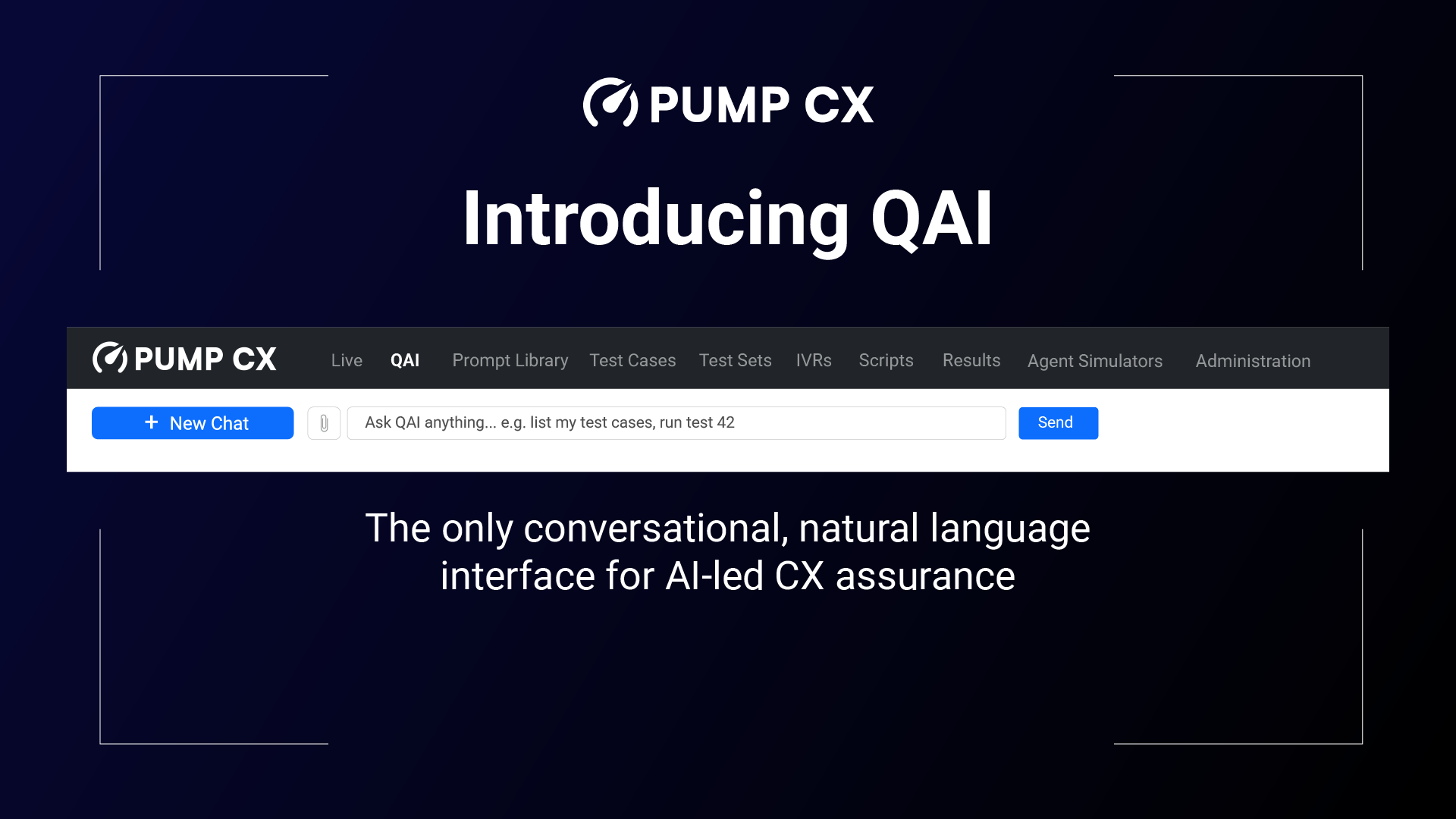
Today we announced the launch of QAI, the newest part of our CX assurance platform and, I believe, the most consequential. QAI is the first and only NLU UI for CX assurance, making customer journey validation accessible to everyone in the organization.
Ask a question about your customer experience in plain language, and QAI builds the test, runs it against your live environment, and returns the evidence. It really is that simple. No scripts. No specialized training. No queue.
Announcements like this usually lead with a feature list. I want to do something different and talk about why QAI exists, because the reason says more about PumpCX than the release notes ever could.
The problem we couldn’t stop seeing
Customer experience in 2026 is mostly automated, mostly voice, and largely untested. Most customer interactions never reach a person first. They meet an IVR, a voice self-service flow, or an AI voice agent, and those systems now carry the brand at the moment of truth. Yet the tools for proving they work were built for a different era: port-based pricing that rations testing, scripting languages that demand specialist skills, and reporting models that collapse the moment a free-text AI response replaces a menu tree.
The consequence showed up in nearly every enterprise contact center we visited. Assurance knowledge lived with a small team of specialists, and every question about the customer experience had to route through them. We watched capable, motivated people — operations leaders, product owners, compliance officers who wait days for an answer they could state in a single sentence. Does the IVR still quote the right return window? How long does it take a caller to reach an agent since the menu change? Did last night’s release break the Spanish-language flow? The bottleneck wasn’t curiosity, and it wasn’t data. It was the interface. To ask a question of your own customer experience, you had to navigate: find the right specialist, get into their queue, wait for a report.
Then AI raised the stakes. Bots are easy to build now; proving they behave in production is where programs break. An AI voice agent is a probabilistic system. Customers express the same intent in a thousand different ways, and failures surface differently on different calls, at different times, under different conditions. Testing one path and checking a box no longer works. You need volume, variety, and continuous monitoring after go-live, exactly when the specialist-and-queue model is least able to keep up.
What is QAI?
QAI is a conversational, natural language interface for building, running, and reporting on CX assurance tests across IVR, voice AI agents, and digital channels. It removes the translation layer between a question and its answer. Paste a standard Jira user story — “As a new customer calling the main line, I want to press 1 for New Accounts, so I reach the New Accounts menu” — and QAI builds the test case, executes it, and returns pass/fail evidence: prompt played, route confirmed, latency within target, audio quality verified, all captured and exportable for audit.
Or skip the user story and simply ask. Is the voice agent still inside its guardrails on refund questions? What did callers actually hear after yesterday’s release? The same outside-in testing engine that has always powered PumpCX, synthetic customers exercising your stack the way real callers do, now answers to anyone who can type a sentence.
What our customers are telling us
The early feedback has confirmed something we hoped for but couldn’t promise: QAI changes who uses PumpCX. Customers tell us more people across their companies want in. Not just QA engineers, but operations managers verifying a change before the Monday call, compliance teams pulling evidence on demand, CX leaders checking what customers actually hear. When the interface is a question instead of a script, assurance stops being a specialist function and becomes a shared utility. That is the outcome we care about most, because every person who can ask is one less blind spot in your customer experience.
What we believe executives actually want
We hold a strong belief about the executive perspective, and QAI is partly a product of it: executives don’t want more dashboards. They want answers they can trust, delivered in the language of risk and return.
The evidence says they’re right to think that way. Watermark Consulting’s long-running Customer Experience ROI Study shows CX leaders delivering 7.8 times the total shareholder return of laggards over 18 years. Those experiences are now mostly automated, which means the gap is increasingly decided by whether voice and AI systems are continuously tested and monitored or merely assumed to work. And when an AI deployment misbehaves, the cost lands where the original ROI model never carried it: wrong promises honored at scale, compliance exposure, eroded trust, delayed rollouts.
An executive shouldn’t have to wait for a quarterly readout to know whether the systems carrying the brand are behaving. With QAI, the question “are we inside policy?” has a same-day, evidence-backed answer and the person asking can be the CFO, the chief customer officer, or the board’s risk committee, not just the testing team.
Why customers are switching from legacy platforms
QAI may be the newest reason organizations are moving to PumpCX, but it isn’t the first. A federal agency had spent years investing millions of dollars annually with an incumbent test automation vendor that repeatedly under-delivered. We asked for the chance to prove ourselves in a live evaluation. Six weeks later, we had.
Two years on, PumpCX delivers 100% of the agency’s automated testing requirements with zero SLA breaches and approximately 50% lower total cost of ownership. The agency has since doubled its commitment, extending its contract from three years to six. For us, this is what trust looks like: measurable outcomes, operational reliability, and the confidence to commit for the long term.
The pattern repeats because the model is different. Agent-based pricing instead of port-based scarcity, so testing is never rationed. Vendor-neutral, outside-in assurance, so you’re never dependent on the platform that built your bot to grade its own work. Outcome-based delivery, so we’re paid for what works, not what was promised. Customers who switch don’t look back, because the thing they left was the compromise itself.
Innovation is a partnership
QAI did not come out of a lab. It came out of customer conversations. The recurring moment when someone said “I just want to know if it works” and the honest answer involved a backlog. Our customers told us where assurance was stuck. We built the way out. That is what innovation in partnership means to us, and QAI will keep growing the same way: shaped by the questions our customers most need answered.
If you run an enterprise contact center, let us run a live test against your IVR or voice AI agent and show you what you can’t see today. Request a demo of QAI to see it on your own stack.
Ask. Don’t navigate. #AskDontNavigate