
IVR TESTING GUIDE
IVR Testing: How to test an IVR, end to end
By Mark Ryan, VP of Solution Architecture, PumpCX | Last updated Oct. 2026
THE SHORT ANSWER
IVR testing checks that callers reach the right outcome through your interactive voice response system: menus, prompts, speech recognition, data lookups and transfers all behave as designed. The test that matters runs the whole call, from the carrier leg through the IVR, any AI agent, routing, and finally, the handoff to a live agent, because that is where most customer journeys break.
What is IVR testing?
IVR testing is the practice of placing calls into an IVR and checking each step against an expected outcome, so you know callers can get where they need to go. Most IVR testing stops at the components: the menu plays, the digit registers, the prompt is the right one. A caller who hears every prompt correctly and still reaches an agent with none of their details has had a failed call, so the distinction that matters is between testing the components and testing the call.
What should an IVR test check?
An IVR test should check nine things, in the order a call meets them:
-

The carrier leg
Whether the call connects from the number a caller would dial. Carrier-side failures never reach your IVR, so your platform hasnothing to report.
-

Prompts and audio quality
The right prompts, with the audio measured against a quality floor rather than judged by ear. On digital circuits, a MOS below 4.0 is reason to investigate.
-

DTMF and speech input
Valid and invalid digits, no input, timeouts and barge-in, plus spoken input with accents and background noise.
-

Back-end lookups
The data dip that authenticates, personalizes or completes a transaction, and what the caller hears when it is slow or empty.
-

Routing
The correct queue and skill under time-of-day and service-level conditions.
-

Any AI agent in the path
Whether it behaves within its defined policies and guardrails.
-

Escalation
Whether a request for a person is handled and the transfer completes.
-

The handoff
Whether the agent receives the context the caller already gave. Callers notice this first, because being asked for an account number twice tells them the system does not work and suggests the company does not value their time.
-

The agent's screen
Whether the customer record arrives before the agent speaks.
Which type of IVR test do you need?
The type of IVR test you need depends on the question you are asking. Discovery, functional, regression, load, stress, soak, speech recognition and scheduled production testing each answer a different one.
| Test type | The question it answers | When to run it |
|---|---|---|
| Discovery | What does each call flow actually do today, compared with the documentation? | Before a migration, a redesign or any work on an inherited IVR |
| Functional | Does each path in a flow, happy and unhappy, reach the outcome it is supposed to? | Before go-live, and after any change to prompts, menus or routing |
| Regression | Did this change break something that was working? | After every release, platform update or model change |
| Load | Do all the components hold up at the volume you expect? | Before a peak period, a launch or a migration cutover |
| Stress | Where does it break, and how does it fail when it does? | |
| Soak | Does it degrade over a long run, through memory or connection leaks? | Before a peak period, over a duration that matches it |
| Speech recognition | Does it understand real callers, including accents and noise? | Before go-live, and whenever the grammar, model or prompt set changes |
| Scheduled production testing | Is it still working now, and will it hold up through the day? | On any schedule you set, between changes |
Why do IVRs pass testing and still fail customers?
IVRs pass testing and still fail customers when each system is tested in isolation rather than the whole call, end to end. Each component reports its status as green while the caller hangs up. Four failures we see in practice show the pattern.
-
A transaction that never posts
The IVR tells the caller a transaction has gone through, but the backend system does not update the account. The IVR has no way of knowing, so nothing flags a failure.
-
Context lost at the AI agent
The caller agrees to a transfer to a voice bot, which starts from scratch, so the caller repeats the request and authenticates again. The bot did what it was built to do. No call data arrived from the IVR, so it treated the call as new and reported no error.
-
Context lost at the live agent
The bot cannot finish the task and transfers the caller to an agent. The call arrives with no call data, and the agent starts over. In a PumpCX test, the synthetic agent session that answers the call flags the missing data as an error. The result screen further down shows that failure.
-
Right message, wrong place
A call to a multi-state insurance provider's toll-free number was delivered, but the carrier's routing rules mapped the area code to the wrong state. The IVR played the correct message for the wrong regional location.
How do you automate IVR testing, step by step?
IVR test automation uses synthetic callers that place real calls into the live environment and check every step against an expected outcome. Nine steps, and the order matters more than the tooling:
Map what the IVR does now. Call flow discovery produces the current flows, which are often not the flows in the documentation, and gives you the happy paths to build from.
Build the unhappy paths. Each decision point needs at least four: no reply, an invalid reply, a wrong reply and a barge-in. Add repeated errors up to the point that triggers escalation, and check that the agent can see why the call arrived.
Prioritize by volume and consequence. A path used by 2 percent of callers to report a fault can matter more than the one half of them use to check a balance. Run those paths more often, but never instead of the full regression.
Write each test case as steps. Give every step an expected outcome and state what makes it a failure. A single verdict for the whole call tells you it broke, not where. Results for every step are reported when the run finishes, so one failure does not hide the steps after it, and a test can be set to stop at the first error instead.
Prepare test data. Use dedicated test records in the production systems, so the call is real and no customer account is touched. Where regulation rules out test accounts in production, as it can in banking and healthcare, run the test platform on your own premises.
Run it against the live environment, from the number a caller would dial.
Assert at every step, including the handoff and the agent's screen, not only at the end.
Keep the evidence: logs, audio, transcript and payload, with a pass or fail per assertion.
Reuse the same test cases before go-live, after every change and on a schedule in production.
An example test case:
| ID | Your existing naming scheme, for example TC-01-01 |
| Scenario | Billing inquiry, authenticated caller, transfers to a live agent |
| Preconditions | Test account in the CRM, account in good standing, business hours |
| Steps | Dial the published number. Select billing. Enter the account number. Request the balance. Request an agent. |
| Assertions, per step | Call connects. Billing prompt plays within the prompt timeout. Account accepted on first attempt. Balance read matches the CRM value. Transfer completes to the billing queue. Agent screen shows the account before the greeting. |
| Fail condition | Any assertion on any step not met |
| Evidence captured | SIP log, call audio, transcript, CTI payload, pass or fail per assertion |
How do you load test an IVR?
You load test an IVR with synthetic callers placing real calls through the same carrier path and platform a customer would reach, so no customer is affected and no agent seat is occupied. The test proves a specific number: your measured peak plus the headroom you want evidence for. If you don't have a measured peak, start from the contracted maximum concurrency and call arrival rate, and what happens when each is exceeded.
Set pass criteria before you start, from the deployment's maximum capacity, the volumes you need to support and the carrier capacity in your contract. Ladder the volume up in levels, then push past your peak to find the maximum calls per second and concurrency the environment holds. Soak at about 80 percent of those maximums for 6 to 12 hours to find slow leaks. For more on load and performance testing, see PumpCX performance testing.
When should you run IVR regression testing?
Run IVR regression testing after any change that can alter what a caller hears or where they end up: a release, a prompt change, a routing rule, a model or platform update, a carrier change or a migration. Run the full suite, happy and unhappy paths, rather than a sample. Running the full regression is the only way to know a fix did not introduce another break, because it captures the impact of every code change made since the last run. For most enterprises that means 3,000 to 5,000 test cases a day, so check how your testing tool prices that volume. Between changes, run the same test cases on a schedule in production, so you learn that a vendor update broke something before your customers do.
3,000 to 5,000
test cases in a typical daily regression run for a mid-sized enterprise
What evidence should an IVR test produce?
An IVR test should produce a record of what happened, not only a pass or fail: the SIP log, the call audio, a transcript, the CTI payload that reached the agent desktop and a result for every assertion, all timestamped. A pass or fail is a conclusion, and evidence is what you need when two teams disagree about whose system broke the call. The signaling record, the payload and the routing decision are what let you attribute a failure to a seam between systems rather than to one system, and the timestamps tie them together.
In the result shown, the call connected, the conversation completed and every voice quality and transcript assertion passed. The call data the agent should have received was missing, so the interaction data check failed while every component reported success.
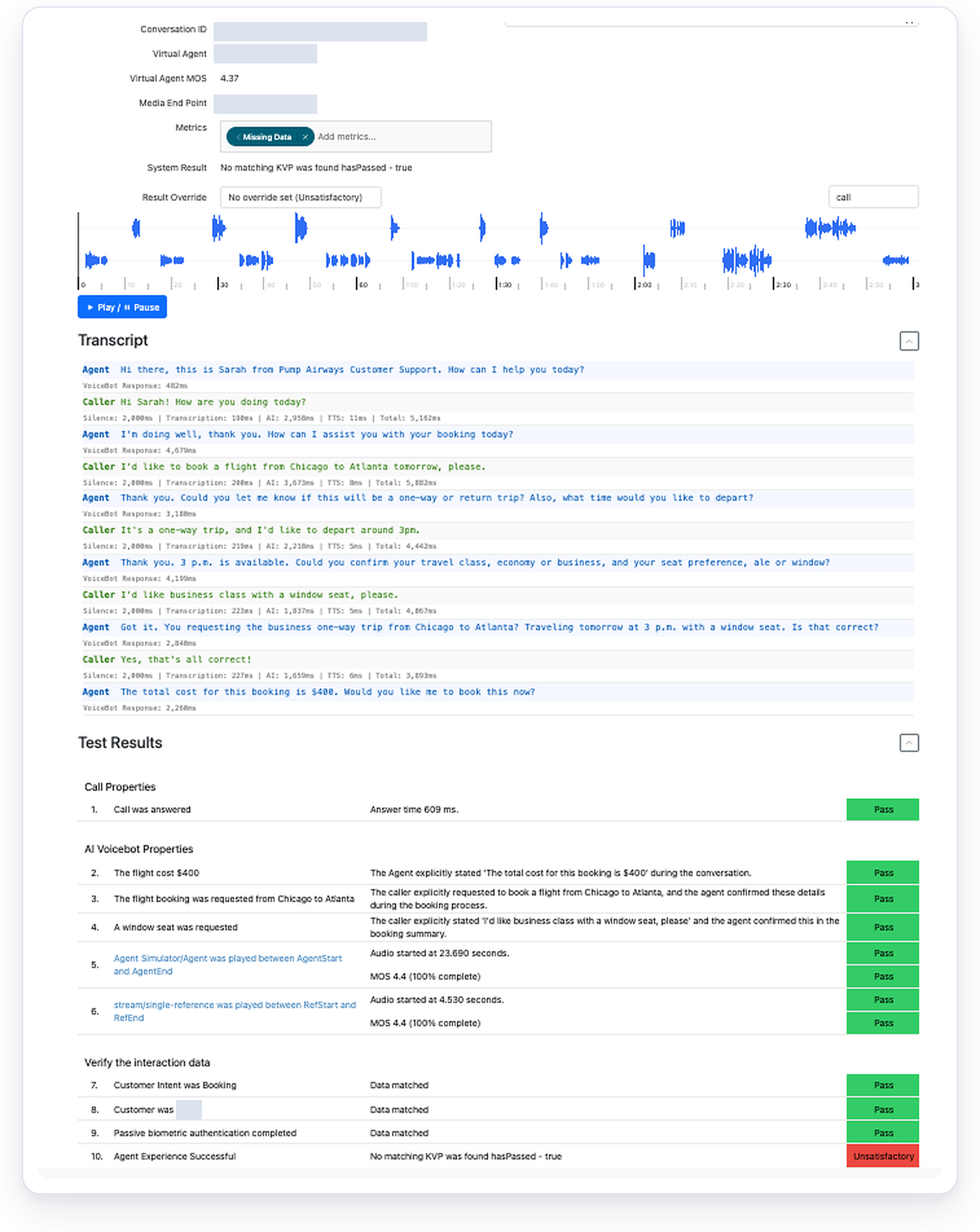

The caller is synthetic. The test is real. The evidence is independent.
How do you choose an IVR testing tool?
Choose an IVR testing tool on what it can prove, not on its feature list. Most of these questions need a demonstration rather than a yes.
| Ask the vendor | Why it matters |
|---|---|
| When the IVR, AI agent and routing all report success and the caller still failed, what in the record shows which seam broke? | This is the failure component testing misses |
| Does the test prove the agent received the caller's context before the greeting? | A connected transfer is not a completed handoff |
| Can a CX or operations lead create a test, and how long does the first one take? | Testing that needs specialists becomes a bottleneck |
| Do the same test cases run before go-live and in production? | Two suites means double the maintenance |
| Does it cover your current platform and the one you are migrating to, with the same tests? | Migrations are where regressions cluster |
| How does cost move as test volume grows, and what is priced by capacity? | Capacity pricing pushes teams to test less |
TESTED. TRUSTED. ASSURED.
How does PumpCX approach IVR testing?
PumpCX tests the whole customer journey, of which the IVR is a single part. Each test case, within the full regression set of test cases, will span the IVR, any AI agent, routing, the CTI screen pop and the live-agent handoff, so that a failure at any seam shows up in the test results alongside all the other test results. Synthetic customers and synthetic agent sessions run real calls through your live environment, and every test returns SIP logs, audio, transcripts and CTI payloads with a result for each step. Test before go-live. Verify in production on any schedule you set.
PumpCX runs outside the platforms it tests, on your infrastructure, on ours or deliberately split across both. Everyday testing and regression are not rationed by a port count. PumpCX's AI assurance is natively built, developed in-house rather than bolted on or added by acquisition, so one platform tests everything from the IVR to the AI agent in one test case, with the same evidence. QAI, our prompt-driven, conversational UI, lets CX and operations teams create and run tests using conversational language.
Frequently Asked Questions
-
Yes. Automated IVR testing uses a synthetic caller to place real calls into the live environment and check each step against the expected outcome. A test suite that takes a team days to manually execute runs unattended, repeats identically and can run on a schedule in production.
-
Run the full set of functional tests, happy and unhappy paths, against the live environment from the number a caller would dial, then load test to your forecast peak. Assert at every step, including the handoff and the agent's screen, and keep the evidence. After launch, the same test cases become your regression suite and your scheduled production tests.
-
IVRs and AI agents are fundamentally different, resulting in testing approaches that are unique to each. The important question is whether the AI agent is tested inside the same test case as the IVR, the routing and the live-agent handoff, or in a test of its own. A fluent answer from an AI agent is not a completed call, so a test that stops at the AI conversation leaves the part customers complain about untested. PumpCX tests the IVR, the AI agent, the routing and the live-agent handoff in one test case, with the same evidence for each. Using a single test case is the effective approach to testing the full journey.
-
Assert against the source. The test knows the balance in the CRM and checks the spoken figure against it, with the transcript kept as the record. The same approach covers names, dates, reference numbers and anything else read back to a caller.
-
Use dedicated test records in the production systems. The call is real and the caller is not, so the lookup exercises the same integration a customer would hit without touching anyone's account. Where a test has to write, it writes to those records.